A friend in need

The smooth-skinned and often rain-slicked Arbutus tree is only found on the salty, mist drenched coast of Vancouver Island and close surrounds. Growing nowhere else across Canada, its naked trunk is a specific marker in this unique biome. 

Steller’s Jay, the mohawked goth relative of the Blue Jay, is the official bird of British Columbia. Their bright blue and grey heads are often seen foraging in my backyard, alongside red-breasted sapsuckers, hummingbirds, and many others I have yet to identify. 

Sitka, spruce, cedar, and pine are four variations of the towering trees surrounding me, silhouetted against the vibrant sunrises and sunsets that seem to roll in from the open ocean each day. The trees are solemn – ancient, perhaps – and welcoming. 

On rainy days, and there are many, mist hangs heavy and branches drip while moss and fungi proliferate. I’ve learnt how to identify Queen Anne’s Lace, and wild carrot; mountain currant, dill, and the difference between yellow and red cedar. The grey, clouded sky envelops the coast like a weighted blanket, soothing and soft. 

On sunny days, the sky stretches so wide to meet the sea, and from rocky outcrops, the competing brilliance of each blue points back to the shore as if to say “look, so wild.” Branches rustle, and grasses nod in agreement with the Pacific winds.

I moved to the Pacific Northwest just four short months before the pandemic began. I’ve lived in many places, but never somewhere the landscape speaks to me quite like this. The coast of British Columbia has been the soft “oh” of a puzzle piece, long missing, gently dropping into place. I’m grateful for this. 

Many, many people have turned to the natural world for solace this year, and rightfully so. This year has, by necessity, been a time for turning inwards and for introspection. It’s immensely comforting to discover a whole ecosystem, untouched by our fears, continuing on with no concern for us. Nature has been a salve, a distraction, and a comforting friend in this, the year of 2020 – the year where seemingly anything is plausible, so long as it’s causing suffering to someone, somewhere. 

This year has cast a stark spotlight on our systems and our societal philosophies. There are many things we know we need to preserve and improve now. Community. Access to support. Healthcare. Well-funded, innovative science. 

So, what then becomes of our new-found friend Nature, as vaccines emerge and with them, a glimmer of hope? Will we turn our back on a friend in need? 

We can’t continue to admire our backyard roses or wild raspberries in a ditch while ignoring a year where wildfires raged on all continents except Antarctica or the four preceding years of deliberate, willful undoing of crucial regulation and legislation protecting our natural world – a world that grows and migrates across our borders, too. Can we? 

We already know that as humanity encroaches on more wild territory than ever seen in human history, our relationships with the natural world are becoming more fraught with silent risk. As I write this, 58.6 million cases of COVID-19 have been recorded worldwide, stemming from a virus that made the transition to a human host. MERS, a similar respiratory virus, has been percolating in the Middle East for years, jumping from camel to human and back again. SARS and swine flu, mad cow disease, scrapie, and dozens of other potential risks to human health sit in labs, all linked back to one source: animal husbandry. 

Seventeen million mink will be killed by the end of this year, after endemic COVID-19 infection was found in fur factory farms, skipping from mink to human and back again – just like the camels. Whether you feel that seventeen million animals of any sort should be raised and killed for their skin is a personal opinion, but I fail to see how it can be part of a path forward. 

Crop monoculture is not-so-slowly eroding the nutrient-rich topsoil across the globe, leading to desertification of vast tracts of land; this is the same land we rely on to support the food chain delivering broccoli to our local Safeway. Arable land is receding, and monoculture also puts our crops at high risk for targeted pests – if you’ll recall, this year also featured a locust plague – so, what’s going wrong here, and why aren’t we moving faster to do something?

I recognize this has been the year of Very Bad News, and I am not currently helping. However, hidden amongst the overwhelmingly scary list of things we’re doing wrong to the planet is hope.   

Right now, we crowd animals together; we grow monoculture crops; we spray ever-increasing amounts of chemicals in the face of growing evidence that there is, in fact, a better way. Not a more PC way, or a more liberal way, but a science-backed, evidence-based pathway forwards. And herein lies the crux: there is another way. 

Here’s what I’m asking you today. If you have spent any amount of this horrible, no-good, anxiety-riddled year taking solace in your garden, your provincial parks, your local dog park, a lake, a beach, the little herbs growing on your apartment balcony, any small piece of the natural world, please – hold that appreciation close, even when Target opens again. Return the favour; learn more about one single action you can take. Maybe you’ll learn to compost, or just stop littering, or start writing emails to your local politican about environmental policy. Whatever it is, it will be one step on a cumulative path. 

Where does this path lead? It leads towards a future where fewer people will be displaced due to irreversible climate disaster, where agricultural production is sustainable, and where we can all finally sit back and enjoy the damn roses.  
Your own, personal doomsday

I believe everyone has a hidden end-of-world terror scenario tucked away in the storage closet of their mind. Think Doomsday Preppers.

For the uninitiated, Doomsday Preppers is a delight for over-anxious humans who enjoy occasional reality TV. This does not describe me in the slightest. Really. Anyway, the premise of the show is to go off and find humans who truly believe the world is going to end imminently, and then have them show off their impressive preparations (guns! hydroponics! 6 miles of underground tunnels!) while a company that suspiciously specializes in end-of-world disaster prepping rates their survival skills.

I’m totally fascinated by the diversity of the apocalyptic scenarios that humans are prepping for. Economic collapse, super volcanos (google those if you never want to sleep again), and nuclear war are a few fan favourites. I think most people have one of these scenarios tucked away in the recesses of their mind.

Here’s what’s not fucking funny: Mine’s happening right now.

Pandemic.

A creeping, silent sickness hopping around the planet, relying on our human needs, exploiting touch and love and support. Public spaces, doorknobs, strangers and smudged forks all become sinister objects. Illness is such a strange thing to grapple with on a global scale. We grow used to negotiating our own body when sick, allowing ourselves some weakness in a world that asks for strength on tap. But now this thing becomes insidious and grasping and we’re left with too many questions as we crane our necks at the rising curve. (flatten the curve, flatten the curve, flatten the curve we chant, washing our hands)

What’s my point? Jesus, I don’t know. I’m reading the news too much, but I know a lot of you are too. Here’s the thing. Humans are badly wired to respond to crisis in large groups. We’re all looking for someone to tell us what the right thing is, if we’re too worried or not worried enough, if we should buy the pasta or the rice or just book the cruise and go (do. not. do. that. thing.)

Here’s what to do. This is the time to devote yourself to love through individual, personal responsibility for the safety of your community. If you stay home, if I buy only what I need, and if we collectively walk away feeling silly for all the precautions – we kept someone vulnerable safe – and that will add up to a lot of loved, vulnerable someones who will get to enjoy this blue dot for longer, and maybe even watch an episode of Doomsday Preppers.

Oh, and wash your damn hands.


Saskatche-what?

Saskatchewan’s angular name comes from the Cree, “kisiskāciwani-sīpiy”, meaning “swift-flowing-river”. It has other secrets though. This oddly rectangular province is where chokecherries grow in the ditch, black-eyed Susan’s bob on the roadside and the smell of bright canola drifts alongside clouds of grasshoppers; where nightly summer storms roll through the skies visible for miles as they dampen the day’s dusty heat; this province is my home-not-home. Mention visiting Saskatchewan to most Canadians, and you’ll be met with a slightly sympathetic stare. Mention Saskatchewan to most anyone else in most anywhere else, and you’ll be met with glassy eyes, blank looks, or even a ‘Saskatchewhat?’

Land of the living skies, Paris of the Prairies, and miles upon miles of fly-over farmland set out like a patchwork quilt. It’s quiet here, and thriving at the same time. Small bars lurk in corners, quietly boasting one of the best indie music scenes in all of Canada. Summer is festival central. Fine dining is popping up in neighbourhoods gentrifying at a terrifying rate, their organic produce sprouting almost as fast as the housing demand. And yet. In less than 30 minutes you can ride horses in a field, and pick wild strawberries on the roadside. Many hands stay stained all summer with dark berry hues. 

In late August, when the waning summer heat perks back up for a brief few weeks, something unexpected comes to town. Folkfest. This food festival spreads across the whole city, and with a dedicated passport I can flit from one continent’s cuisine to another. Samosas and bratwurst, hula and face painting. The crowing jewel of this event though, is the Ukrainian pavilion. Canada – and the prairies in particular – are home to one of the largest Ukrainian communities in the world, and if you have never tasted a homemade plateful of perogies you just haven’t quite lived. Poutine might be Canada’s guilty pleasure, but potato and cheese perogies are mine. 

I’m forever charmed by this city of bridges, Saskatoon. Whether it’s the winding South Saskatchewan river in spring, the cold winters that leave ice in your veins, or the rumble of those distant summer storms – Saskatchewan gets under your skin, and it stays there. This place is in my blood, of my blood, and nowhere in the world – not even Australia, a scorched and starkly beautiful land in its own right – can erase the prairie girl that lives in me. Considering a visit? Don’t ask Saskatche-what? Ask yourself, Saskatche-when.

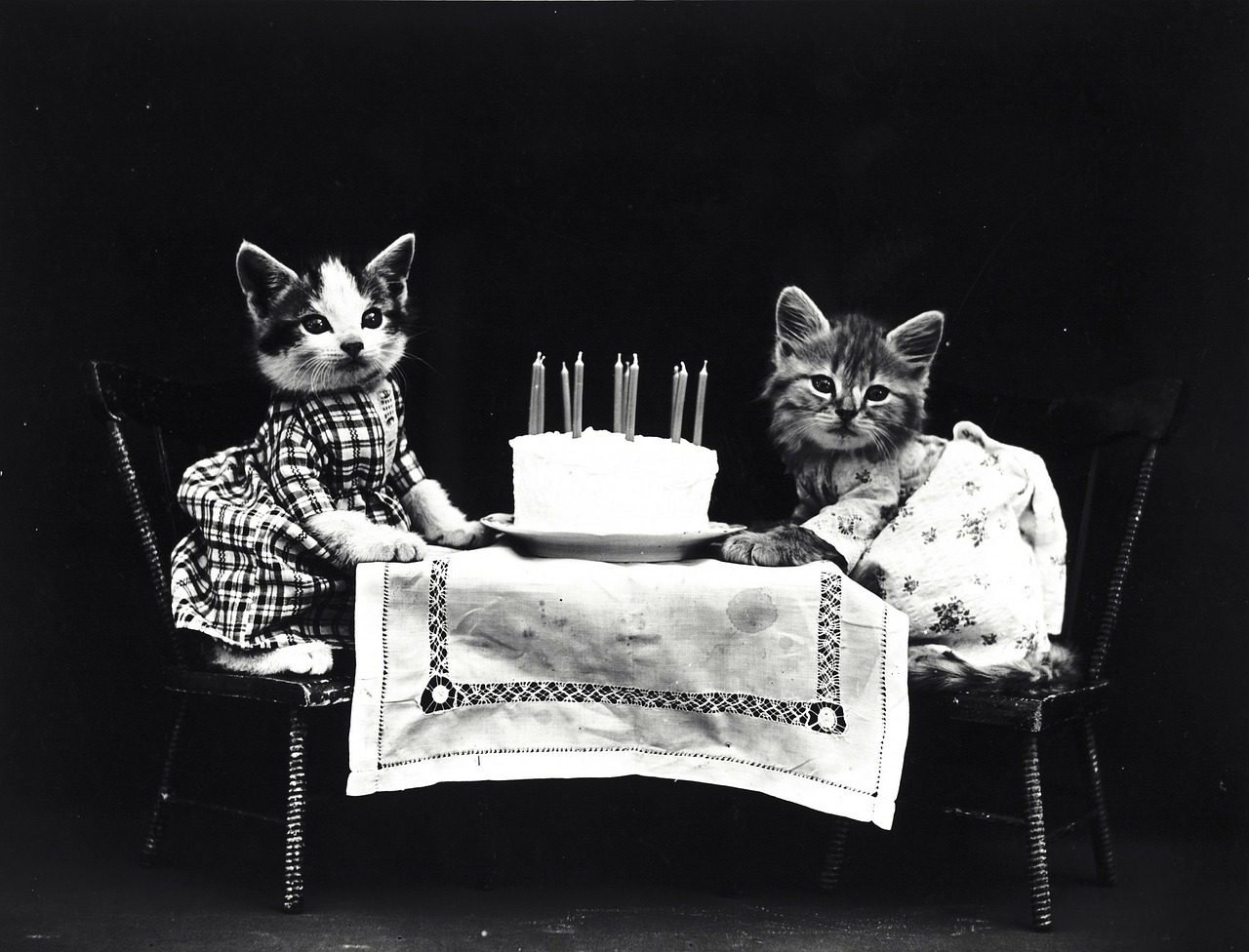
Red glasses, cake, and indifferent cats. This is 30.

I’m turning 30. I’ve been looking for a good excuse to resurrect this blog for some time now, and this seems as good a reason as any. I understand that turning 30 means I should be deeply upset, spending many hours on contemplative introspection. But look, I have friends coming to visit, and I also understand there will be a lot of cake to get through, so. Priorities.

At 15, I could not conceive of myself at 30 – in much the same way that I cannot currently conceive of myself at 60. Attempting to imagine what might change as your years on earth literally double is probably futile anyway. But at 15, many of my friends seemed to have a clear picture of where they would be by 30. Kids, houses, careers; all the usual fare, but somewhat unsettling for me. I had something different. I had a very clear picture of who I wanted to be at 30, but all the details in-between were terribly fuzzy. Older me was improved me, and that’s all I knew.

I wanted her to be a little bit braver, a little bit kinder. Certainly a bit more confident to share her opinions. Maybe someone who wore bright glasses, knew a few jokes, and wasn’t so afraid of looking silly.

I kept thinking about these things. I thought about these things a lot – while I worked at awful jobs, and returned to university, and worried about more or less everything always. I had my eye on the prize. Improved me was going to happen! Turns out, this was not such a bad strategy. Ageing with intention, if you’ll forgive the hippie turn of phrase, is pretty effective.

I did not anticipate spending a decade living in Australia. I did not anticipate meeting my partner at such a young age, certainly not after my teenage self declared I would never do such a thing! The experience of growing with someone has been one of the most illuminating and fulfilling aspects of the last 10 years. I did not anticipate so, so many things. The hollow disconnect of losing family and friends across an ocean, and worse, momentarily forgetting I would never see them again. How heartbreaking it could be to be recognised by a grandmother who is still here, but is living somewhere else in her mind entirely. I did not anticipate watching my loved ones go through illness. I definitely did not anticipate how fast a decade can pass and how ambivalent I could feel about where I spent it.

I also didn’t anticipate weirdly good vacations that came with tropical cyclones, or how much cheap wine a broke 20-something can drink, or how rewarding and terrifying buying a house could be, or any of the many other wonderful things that have happened since my 15 year old self tried to predict the future. I’ve learnt to give speeches without wanting to throw up, and the delicate art of the angry email. I started a business. I talk to my cat. I’ve learnt to appreciate all the small mercies of life and find the beauty therein. Hell, I learnt to cook.

So hey, here I am at 30. Pretty much everything (or nothing) has gone to plan, considering I didn’t have one. But I am happy to report that I am a little bit braver and a little bit kinder. My glasses are red. I still miss my family, a lot.

Three intransitive verbs walk into a bar. They sit. They drink. They leave.

(and I am not afraid to tell you how funny I find that joke.)

What’s the moral of this slightly (ok, very) self-involved story?  Well, I don’t know. My cat walks away in the middle of my sentences. Now if you’ll excuse me, I understand there is cake.

Nonono, wait! I’ve got it!

Wherever you are in life, no matter how lost you feel – maybe it’s not about figuring out where you should be, or what you should be doing, or who you should be with. Taking stock of who you want to be, and taking some baby steps to get there…well, that seems to lead to positive change pretty consistently. I’m looking forward to seeing what the next 10 years will bring, and I’m already thinking about who 40-year old me will be.

The Canadian Apology: Sorry, eh?

Sorry to bother you, but I’d like to talk about something today. The Canadian Sorry.

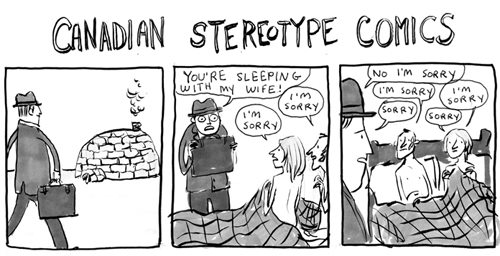
Canadians are subject to stereotypes like all other nations, often suffering them gladly. I have yet to see a backpacker appropriating any other country’s flag, which is an odd, but pleasant compliment.  However, our reputation for extreme politeness has led to a complete global misunderstanding of a unique linguistic habit: the Canadian Sorry.

Image source: Hark, A Vagrant!

The Canadian Sorry stands out as a rich point** in Canadian languaculture; it’s a global stereotype; most Canadians willingly admit their over-usage of sorry; and most non-Canadians COMPLETELY miss the point of the Canadian Sorry.

So. What is the point of all these miscellaneous sorrys then?

As a Canadian I have my own definition and uses for the Canadian Sorry, and I thought it was pretty likely that other Canadians did as well.  So, I politely (ha!) conducted an informal survey via Facebook and Twitter, asking “how is the ‘Canadian Sorry’ different from a regular sorry? How do you use it?” and the responses – all from my wonderful fellow Canadian interneters – sparked a debate and provided a range of answers, many of which overlapped. So, from here I wanted to explore the uses and meanings of this cultural phenomenon.

Canadian+stats.+Sorry+i+see+that+you+are+busy+right_be1e3d_3967305

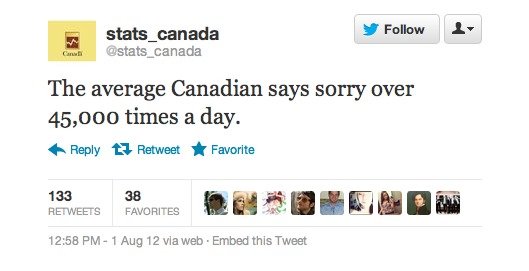
NB: This is a (hopefully obviously) satirical twitter account

Within the languaculture of Canada I think the over-usage of ‘sorry’ functions as a social lubricant, and a useful device to ease communication difficulties.  It’s a marker of politeness, and can be used in situations of both positive and negative face. ‘Sorry’ is used in a wide range of situations and depending on context, has a wide range of meaning; personally, I’d say the least used instance of ‘sorry’ is with actual apologetic intent. Through my own ‘sorrying’ and the responses received from my admittedly small, and informal survey, these are my thoughts on the common situational uses of the Canadian Sorry, and the implied meanings.

The Facebook responses received laid out 9 scenarios in which Canadians use ‘sorry’.

  1. When someone bumps into you
  2. When you bump into someone
  3. When asking someone to repeat themselves
  4. When asking for goods or services, such as the cheque after dinner
  5. When passing someone in a crowded space
  6. Expressing genuine apology
  7. Expressing an empathic state (I’m so sorry to hear that)
  8. In place of thank-you
  9. During a pause in conversation, when your interlocutor is waiting on your response or comment

images

Ian & Will Ferguson, authors of How to be a Canadian (even if you’re already one) claim “Canadians say sorry often, but rarely apologize”.  I tend to agree. Sorry if you don’t.  Let’s examine, shall we?

Scenarios 1, 6 & 7 fall into the category of genuine apologetic or empathic intent, and are largely unremarkable. These uses are common to American, Australian, UK and NZ English speakers as well.

Scenario 8 is totally new to me, but was reported by one Facebook respondent. I really need examples of this one!

Scenario 9 functions as a type of genuine apology, meaning both “sorry to keep you waiting” and “hold on, I’m thinking”. It could also be interpreted as a conversational placeholder, indicating to the interlocutor that the speaker is not yet giving up his or her conversational turn.

Scenarios 2-5 reflect the use of ‘sorry’ as a replacement for ‘excuse me’ or another attention getting linguistic device.  In these instances, sorry can be viewed as an expression of negative politeness. It is worth noting that in English speaking countries, most requests are phrased as indirect speech acts, so the use of sorry is almost a doubling up of negative politeness – “sorry, could I please get the cheque?” is a likely structure for scenario 4.

However, there are definite semantic quirks built into this proliferation of sorry.

Take scenario 1. Here’s what we really mean.

Bill: *is bumped into*

Bill: “sorry”
gloss: [WHAT AM I, INVISIBLE? I’M RIGHT HERE BUDDY]

Ted: “sorry!”

Bill: “…”
gloss: [Oh, well then. Ok.]

~ Life carries on ~

A prime example of this comes from a Canadian friend living in Australia who shared a story about going grocery shopping; a stranger bumped into her in the aisle, and my Canadian friend responded with an automatic ‘sorry’. However, the stranger didn’t respond, and as the individual walked away, my now irritated friend called out “Fine, then I’m not sorry!”

Overall, I’d call the Canadian Sorry a politeness strategy that functions broadly as a social lubricant. Canadians will ask for what they want, and aren’t afraid to do so – however, we’d prefer to be polite while doing the asking.  Utilising the Canadian Sorry as we do allows us to politely make our needs and wants known, without overtly imposing on others.  If that confuses the rest of the world, well, we’re sorry about that.

** A languacultural rich point is linguistically simple upon first assessment, but also contains a layered richness of cultural and semantic meaning. This variation of cultural and semantic meanings will contain commonalities that participants in the native culture will identify with, but it will also contain a set of differences, which provokes (often fierce) debate among the same native culture participants.

uxf0D29621